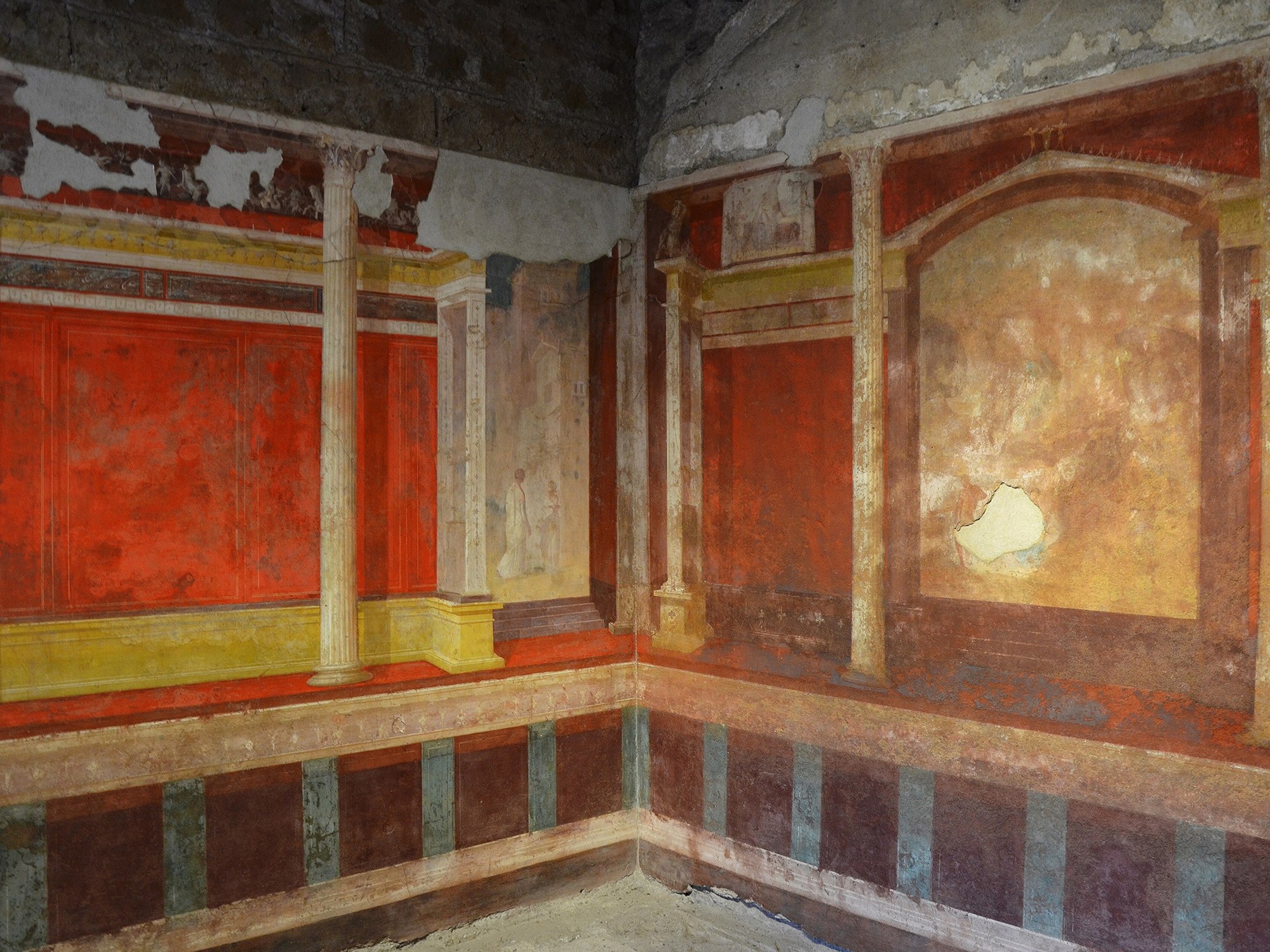
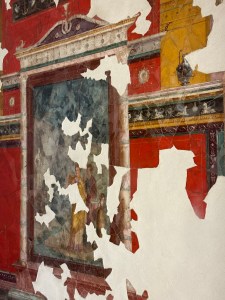
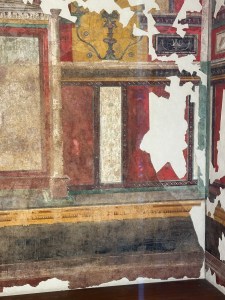
It never ceases to amaze me, but places like the home of Rome’s first emperor, Augustus, are still with us. While Augustus’ propaganda lauded his thrifty and almost austere lifestyle (after all, he never claimed to be an emperor, merely the “First Citizen,” while steadily seizing power), his house on the Palatine Hill contains exquisite examples of ancient Roman wall painting. The frescoes are painted in the “second Pompeiian style,” colorful paintings (including a lovely red) that often feature a kind of three-dimensional architecture. And, they are just plain beautiful.
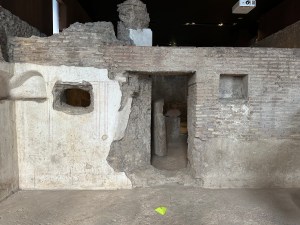
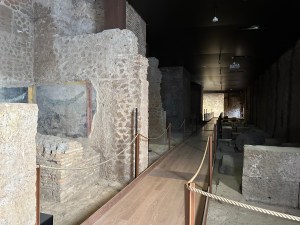
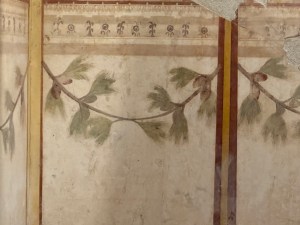
The “Pine Room” has a beautiful, if simple, design scheme with festoons of pine branches.
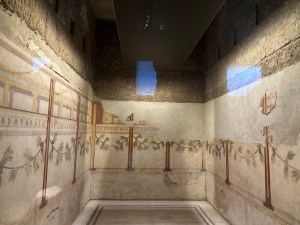
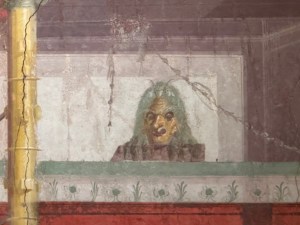
The “Room of the Masks,” adjacent to the “Pine Room,” is more elaborate. Second-Style perspective paintings incorporate tragic and comic theatre masks.
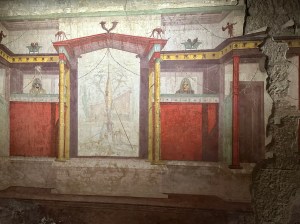
Next to the two cubiculae is a series of five rooms of various sizes arranged along the north side of the western court. The rooms include two libraries (or maybe rooms to display artworks) and a tablinum (where Augustus would receive guests) flanked by two alae (wings) on either side. One of the two alae, dubbed “Room of the Perspective Paintings”, has vividly-coloured frescoes on its north wall depicting a two-storey architectural facade in blue, white, yellow, and red.
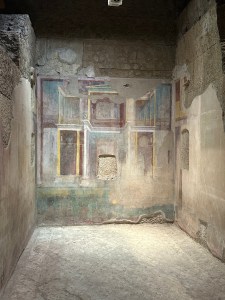
We next arrived at the “Ramp Room,” which shows that even the ceilings here were painted. The painted vaulting imitates a coffered ceiling with painted geometric shapes — square coffers with a rosette in the center.
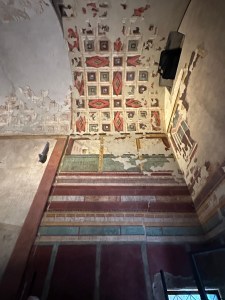
The next room is the so-called “Large Oecus” (room 13), with architectural wall paintings with four pedestals for columns of piers (oecus tetrastilus – supported by four columns). The room served as a salon where elaborate dinner parties were held, among other functions.
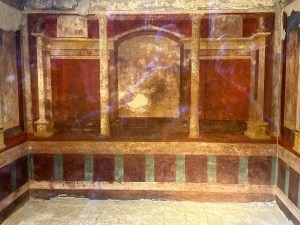
The final room, a cubiculum known as “The Emperor’s Study”, where the Emperor would retire to when he did not want to be disturbed. It is located on the highest level of the house. Today, it is accessed by climbing a modern steel staircase and can be viewed by peering through protective glass. The exceptional decorative elements were inspired by Egyptian-Alexandrine models, typical of the art of the Augustan period after the recent conquest of Egypt.
You can see the House of Augustus, as well as other treasures, in the next few posts, through a ticket for the “Super Sites” in the Roman Forum and Palatine Hill. Fortunately for us all, his wife’s house is just a few steps away.


One thought on “The House of Augustus”
Comments are closed.