
On one lovely morning, we were two of a number of people hanging out on a sidewalk on the Oppian Hill, a minute away from the Colosseum. Many people walked past us, heading for the Colosseum, possibly wondering about the bunch of geeks standing by a nondescript small metal door, on which was some random graffiti. The door sits in a brick wall that we had walked or driven by many times. But today, that little door was going to open for us, as part of Open House Rome.
We all hovered excitedly as a gentleman arrived with the key and opened the little door.

Soon, thanks to a spiral metal staircase, we were directed downward perhaps 25 feet below street level and 2,000 years back in time. The staircase is very old, so we had to go down it one at a time.

When we got to the bottom of the staircase, we were standing where the ground level was before the Great Fire of 64 C.E. — the fire that burned while the “mad” Emperor Nero legendarily played his fiddle. After the fire, Nero claimed much of the land in this area to build his “Golden House,” the Domus Aurea. The place where we were standing had been filled in with rubble after the Great Fire, when the land was taken over by Nero to build his gigantic estate.
But before the Great Fire, it had likely been part of a beautiful garden. Within that garden was an enormous water fountain — likely the pride and joy of the garden’s owner. Today, it is known as the nymphaeum of Annibaldi.

A nymphaeum was a structure dedicated to the minor nature deities known as nymphs, who were often associated with water, such as springs, lakes, or oceans.* As nymphs were beautiful, nubile young women who, shall we say, were the original nymphomaniacs, a nymphaeum would have been a place associated with a very, very fun party.
This one would have been really expensive and quite breathtaking. What we see today is just a tiny section of what would have been a massive fountain, surrounding a luxurious outdoor dining area, with water flowing in curved channels around the patio.

Statues, probably of curvaceous nymphs, would have stood in the little niches.

Designed to suggest a rustic grotto, the fountain had intentionally rough surfaces to remind you of oceanic rocks, and which were dotted with natural shells, some of which were specifically chosen as they were shiny. There were also many blown glass inserts (now gone) that would have sparkled and reflected the light.

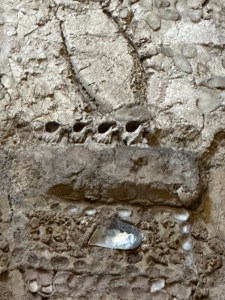
Water would cascade from above the decorations, creating a rough curtain of water streaming down in front of the sparkling walls. At the bottom, the water would pool to a shallow depth. The cascading water hitting the pool would create a fine mist and soothing sound. All this would combine into an experience of glimmering walls, glistening water, and cooling air. In the evening, the fountain would have shimmered in the twilight. Both day and night, it would have been quite magical.

That cool mist would have been very refreshing on a hot summer’s day or evening as you enjoyed some delicious seafood and drank chilled wine with friends. Not a bad way to enjoy an evening in the Eternal City.
*Of course, the definition of a nymph makes me remember the line from Monty Python and the Holy Grail, about the reaction of a peasant to King Arthur’s story about how he is king because the Lady of the Lake gave him Excalibur: “You can’t expect to wield supreme executive power just ’cause some watery tart threw a sword at you!”

 The Spanish Steps Apartment on Via della Mercede