We are enormous fans of the Open House Rome. We even schedule our time in Rome around it. This year, we were able to go on a very special visit. Actually, more than one — stay tuned for some future posts.
It goes without saying, the ancient Romans knew how to build. Indeed, elements of ancient Roman infrastructure are still functioning today. And, we got to see one of them, doing just what it was always meant to do. It was a rare treat.
The Aqua Virgo aqueduct was built by one of my favorite Ancient Romans, Marcus Agrippa, in 19 B.C.E. It still sends spring water into Rome. That’s over 2000 years! It’s the last functioning ancient aqueduct.
We think of the Roman aqueducts as those graceful stone arches out in the Roman countryside. But, this one was routed all the way into the heart of the historic center. Ancient Roman aqueducts were designed with branches. Parts of the Aqua Virgo’s branches, which are now dry, lie in the basement of the fancy Rinascente a few minutes’ walk from us (there’s a brief free sound and light show about it, worth seeing). There is also a small section of aqueduct you can see in a tiny alley not far from us, on Via del Nazzareno. You inevitably walk by this section when heading over to the Trevi area. A part of the aqueduct that still functions lies deep under Villa Medici, and this branch continues into the city’s heart where it feeds many of the famous fountains — as well as, I was once told, my apartment.
Having signed up with Open House Rome, we showed up at the designated time at Villa Medici. The exact spot was at a nondescript door, under a sign that most people would never notice, but which was clearly creating a lot of excitement this morning.


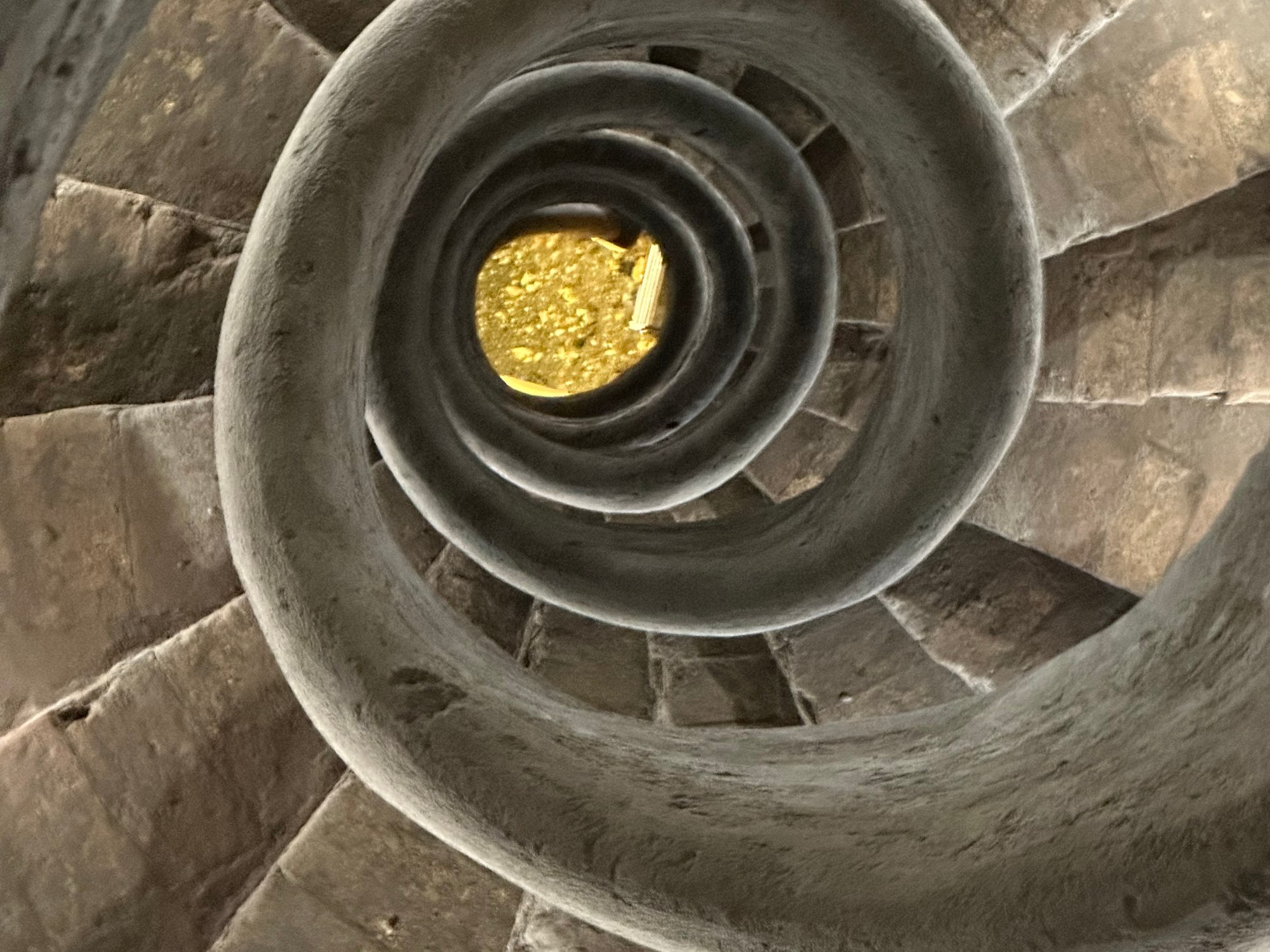
You reach the aqueduct down a spiral staircase (as seen at the top of this post), nicknamed the Snail. Indeed, that’s what is on the sign — Aqua Virgo [Acqua Vergini in Latin], by the Snail of the Pincio. We passed through the doorway, and began our descent.
We all chuckled now and then as we got a little dizzy going round and round and round, slowly descending 82 feet (25 meters) on this well-built staircase from the 15th century. The height of the steps felt ordinary. So, estimating a 7-inch height, that means we descended about 140 steps.


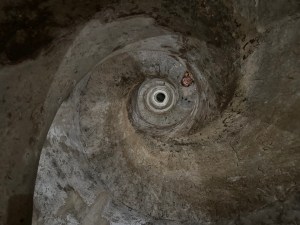
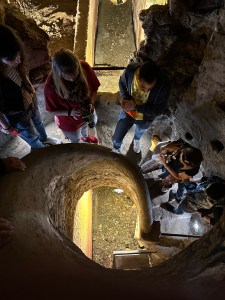
The aqueduct is at a level much lower than Villa Medici which is built on the Pincian Hill. The aqueduct lies at the level of Piazza de Spagna, about 25 meters below the villa.
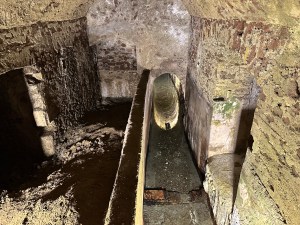

When we got to the bottom we all stood there as quietly as possible, enjoying the gentle sound of flowing spring water. The dramatic lighting gives it the gold glow.
Various legends surround the name Virgo: a pure “virgin” girl showed parched Roman soldiers the spring that is the water’s source; the water is pure as it suffers no “defilement” from the earth; and that the water first entered Rome on the feast day of Vesta, leading to naming the water after the Vestal Virgins.
Much of what we see today, and the beautiful spiral staircase, was from when the aqueduct was rebuilt in the Renaissance. Water was delivered up to the villa using an ingenious mechanism. Before that was built, people had to visit a well or cistern to collect water.
Having visited the bottom, no one in our 20-person group was looking forward to the climb back up. There were some high-fives when we finally made it. Everyone, though, agreed it was an unforgettable, awe inspiring, visit.
Walking home, we stopped for a drink at our favorite fountain, in Piazza di Spagna. That water still flows there, cool and refreshing, thanks to the Aqua Virgo.

 The Spanish Steps Apartment on Via della Mercede
One thought on “The Snail (Chiocciola del Pincio)”
Comments are closed.