
Next to the church of Sant’Agostino is a tiny sliver of a building, behind a gate. If the gate is open, you should go in.

Inside, you walk up the steep curving stairs, to where the guardian awaits.

If she lets you in, you enter a place a great beauty — the Bibliotheca Angelica, a venerable old (1604!) library that looks like something out of Harry Potter.

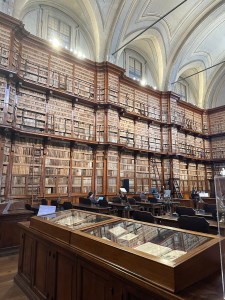
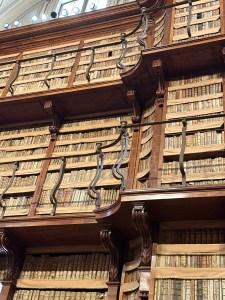
To those of us who love libraries, it’s a place as sacred as a church, and you stand there in respectful, quiet awe. Indeed, silence is mandatory since it’s a functioning library.
This library is named after the Augustinian bishop Angelo Rocca (1546-1620), who was in charge of the Vatican Printing House under Pope Sixtus V. The Pope’s book collection was donated to the friars of the monastery of St. Augustine in Rome, and started the core of the library.

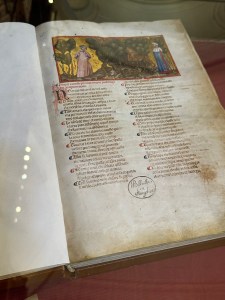
Besides books, the library is home to manuscripts, prints, and globes, some of which are exhibited. When we were there, we were treated to a 14th century version of Dante’s Divine Comedy:
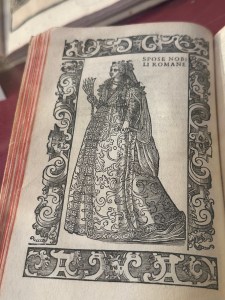
There was also a cook book with marvelous sketches of cooking accoutrements:

The books on display were beautiful, to say the least:


The globes in particular were works of art.


Locked behind protective cabinets were some very, very old books.

Interestingly, the Biblioteca Angelica is home to thousands of books that were once deemed heretical and therefore banned by the Vatican. Bishop Rocca somehow managed to get the permission of the pope to retain these banned books, such as writings by Giordano Bruno (whose statue stands in Campo de’ Fiori, where he was burned at the stake) and Galileo Galilei, who once faced the Roman Inquisition.
It’s a magnificent place, well worth a visit. And it’s free. From the library, you can easily head to another wonderful spot, Piazza Navona.

 The Spanish Steps Apartment on Via della Mercede