
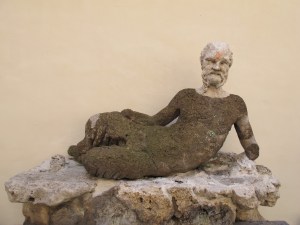
The talking statues of Rome (also known as the “Congregation of Wits”) were outlets for anonymous, often caustic, political expression in Rome beginning in the 16th century. Criticisms in the form of poems or witticisms were posted on these statues throughout Rome who “talked” to each other through the postings. The pope and his court were frequent subjects. The most famous of the talking statues is Pasquino:

Indeed, a “pasquinade” is a public satire. Pasquino is located in a little piazza named after him, near the south end of Piazza Navona. The statute represents Menelaus, the husband of the legendary Helen of Troy; this particular pose is one of Menelaus supporting the body of his son (which is obviously now missing).
A few minutes walk from us is Il Babuino. Legend has it the battered statue was fished out of a river and was considered so ugly that people thought he looked like a “baboon,” hence his name. Despite his unattractiveness, he sits in a place of honor on one of Rome’s ritziest streets which is also named after him, near the Spanish Steps. You’ll notice his head doesn’t quite match … but at least he has one.
Another talking statue, Abbot Luigi, keeps losing his.
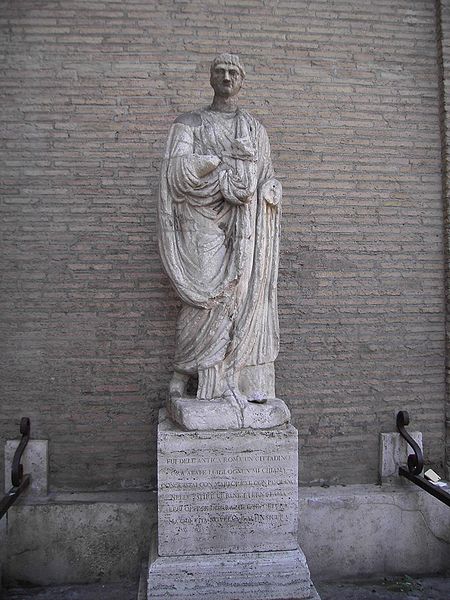
Abbot Luigi is the Rodney Dangerfield of talking statues: he gets no respect and his head has disappeared numerous times over the centuries. Apparently his head was recently stolen again… but don’t worry, it was a copy. Marforio, a hunky statue if there ever was one, does get respect, and a great location on the Campidoglio:

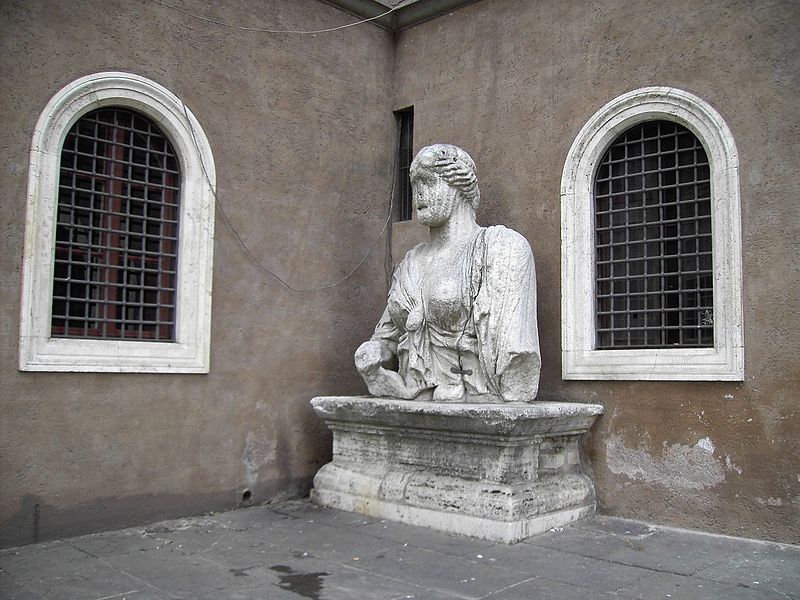
There’s only one lady talking statue, the voluptuous Madama Lucrezia, who lives in a little corner on Piazza Venezia:
The last talking statue is Il Facchino (the Porter), pictured at the top of this post. He’s a later addition to the talking statues, and is a portly little man in a floppy hat carrying a wine or water cask. As he’s actually a drinking fountain: water flows out of the bunghole.
Pasquino’s always been the most vocal of the group. People posted letters on his base, which is how he “talked,” until 2011, when the right-wing mayor, Gianni Alemanno, decided that the posts had to be placed on a small board next to the statue’s base. Rumor has it this was to reduce criticism of the mayor, or of Silvio Berlusconi, a frequent target of Pasquino’s wit. Well, welcome to the new millennium, gentlemen: Pasquino’s on the internet, as well as on his board. And, last year, two new statues in Rome started talking.

 The Spanish Steps Apartment on Via della Mercede